
Scritchy Scratchy prestige: When to Reset and Grow
Learn how Scritchy Scratchy prestige works, when to reset, and how to plan upgrades for stronger future runs. Includes quick-reference tables and an FAQ.
Jump to
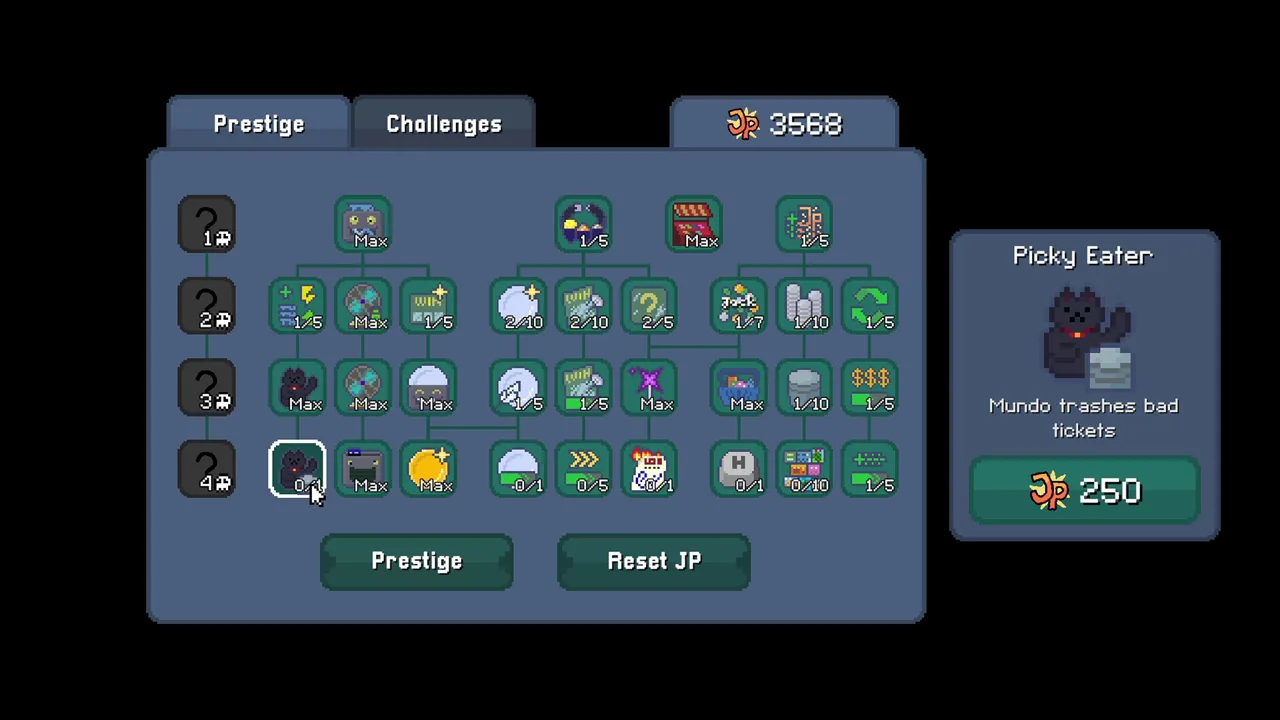
What Scritchy Scratchy Prestige Does
A promising run can feel hard to give up, especially when you have built up cash and upgrades. Scritchy Scratchy prestige matters because it turns a reset into a way to strengthen future runs. Understanding what carries over—and when to make the trade—can help you avoid resetting before you can afford useful permanent upgrades.
The supplied Scritchy Scratchy FAQ describes prestige as a reset that grants Prestige Points, abbreviated JP, after you unlock the system and hit jackpots. You can spend those points in a permanent upgrade tree, and the bonuses carry into later playthroughs. That makes Scritchy Scratchy prestige a long-term progression choice: you give up current-run progress to improve what comes next.
| Prestige detail | What the FAQ says | Practical takeaway |
|---|---|---|
| What resets | Your current progress restarts | A reset begins another run |
| What you gain | Prestige Points, or JP, from jackpots after prestige is unlocked | JP can be spent in the permanent upgrade tree |
| What you can buy | Permanent upgrades in a tree | The tree is where Prestige Points are spent |
| What carries forward | Permanent bonuses carry into future runs | Those bonuses contribute to later playthroughs |
The source does not provide a precise formula for earning JP, a full upgrade-tree list, or a specific threshold for the first reset. Treat those details as unknown rather than relying on a guessed target. For the supplied mechanics, see the Scritchy Scratchy FAQ guide, the reference page used for this article.
Prestige fits into a broader incremental game loop. You scratch virtual tickets, earn money from winning combinations, buy upgrades that improve scratching, and eventually automate some of the work. The FAQ describes more than 10 card types with different mechanics and prize structures, but it does not give a complete list of payouts or a point-by-point prestige chart. That means a useful reset plan can follow the stated principles without assuming exact numbers: earn JP after unlocking prestige, spend it on permanent upgrades, and account for the current run restarting.
Prepare Your Run Before You Prestige
Prestige is most useful when you approach Scritchy Scratchy prestige as part of a cycle, rather than as a button to press as soon as it appears. The FAQ advises waiting until you have accumulated enough Prestige Points to make meaningful purchases, then considering a reset when progress in the current run has slowed. Since it gives no exact point goal, the source-backed timing guidance is about meaningful purchases and a slowing run, not a fixed balance.
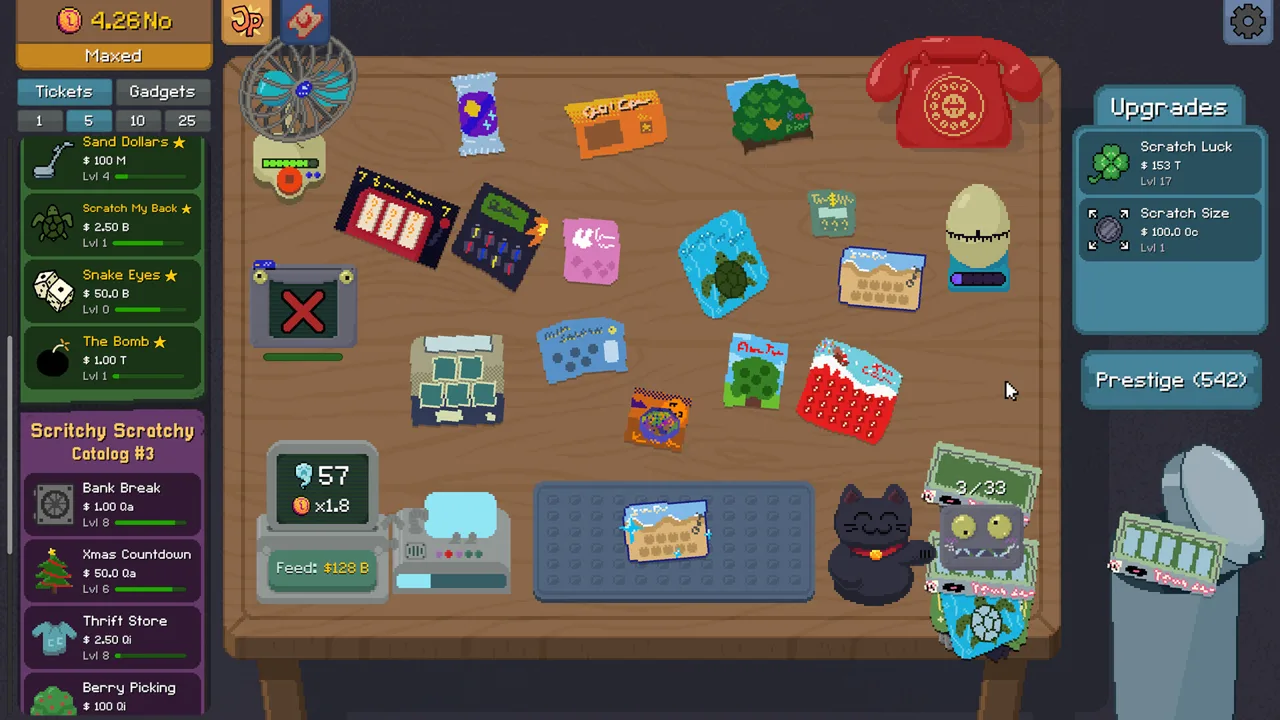 Image: Steam / Lunch Money Games
The game’s income and scratching systems help explain why each run can feel different. Players manually drag the cursor across ticket surfaces to reveal symbols. Scratch Power affects how much each stroke reveals, while Scratch Area Size controls the width of the scratching zone. These are run upgrades; prestige, by contrast, provides points for a permanent upgrade tree. Keeping those systems distinct makes it easier to understand what a reset is meant to change.
| Before you reset | What the FAQ supports |
|---|---|
| JP and the permanent tree | Prestige Points can be spent on permanent upgrades |
| Current progress | The FAQ suggests considering prestige when progression has slowed |
| Scratching upgrades | Scratch Power affects the amount revealed per stroke |
| Scratching area | Scratch Area Size determines the width of the scratching zone |
| Automation | The Auto Scratcher processes cards automatically once unlocked |
A good approach is to use the FAQ’s two stated timing considerations together: whether progress has slowed and whether your Prestige Points can support meaningful permanent purchases. The source does not give a mathematical break-even point, exact JP target, or guaranteed outcome for a reset. It also does not specify which permanent purchase is right for every run, so avoid treating an assumed threshold as a game rule.
The Auto Scratcher adds another part to the progression picture. Once unlocked, it processes cards in the background, and the FAQ says its capacity and processing speed can be upgraded. Those details describe automation in a run; they do not establish a required pre-reset checklist. The point of prestige remains the permanent bonus cycle described by the FAQ, while the Auto Scratcher is one of the game’s systems for handling cards.
Build a Stronger Next Run
A reset does not remove the need to manage money and upgrades carefully in Scritchy Scratchy prestige. The FAQ suggests building a luck foundation early, then unlocking the Auto Scratcher as soon as practical. After that, it recommends balancing Scratch Power and Scratch Area Size for manual play, followed by multiplier upgrades and Auto Scratcher capacity improvements later on.
 Image: YouTube / Joe Bart Games
The source presents this as a general upgrade sequence. Luck is the suggested early focus; the Auto Scratcher supports background processing after it is unlocked; Scratch Power and Scratch Area Size improve different parts of manual scratching; and multiplier upgrades and capacity enhancements are later-stage priorities. It does not provide exact costs, level caps for each upgrade, or a required number of purchases before prestige.
| Upgrade or system | Role described in the FAQ | Place in the suggested sequence |
|---|---|---|
| Luck | Provides an early upgrade focus | Start by building a luck foundation |
| Auto Scratcher | Processes cards automatically after unlocking | Work toward unlocking it early |
| Scratch Power | Affects how much each stroke reveals | Balance with Scratch Area Size |
| Scratch Area Size | Affects the width of the scratching zone | Balance with Scratch Power |
| Multipliers | Described as later-stage upgrades | Focus on them later |
| Auto Scratcher capacity | Lets the device process more cards | Improve it in later stages |
Card choice also affects how a run earns money. The FAQ describes Quick Cash and simple matching cards as generally consistent options. Apple Tree and Lucky Cat involve risk-and-reward decisions, while Snake Eyes is heavily luck-dependent and is described as a poor expected-return choice until you have substantial capital. No odds, costs, or payout amounts are supplied, so those descriptions are broad guidance rather than a numerical ranking.
| Card mentioned | Description in the FAQ | Source-backed context |
|---|---|---|
| Quick Cash | Generally provides consistent returns | One of the card types described as a consistent option |
| Simple matching cards | Generally provide consistent returns | Grouped with Quick Cash in the FAQ’s strategy advice |
| Apple Tree | Involves risk and reward | The FAQ advises weighing the decision carefully |
| Lucky Cat | Involves risk and reward | The FAQ advises weighing the decision carefully |
| Snake Eyes | Heavily luck-dependent | The FAQ suggests avoiding it until you have substantial capital |
Some cards have penalty symbols. The FAQ describes partially scratching a card to peek at its outcome before committing to a full reveal. A good approach is to use this mechanic to look for dangerous symbols before revealing more, especially on cards where a penalty can subtract money. The FAQ gives two examples: on Scratch My Back, distinguish beneficial jellyfish from harmful plastic bags; on Snake Eyes, scratch corners to identify ones, which have no dot in at least one corner, and avoid them.
Choose Your Reset Timing Carefully
There is no exact universal moment to prestige in Scritchy Scratchy prestige, based on the supplied information. The FAQ’s guidance is to wait until your points support meaningful permanent upgrades and the current run has slowed enough that a reset could speed up the next cycle. It does not state a fixed time, JP balance, or milestone that applies to every run.
 Image: YouTube / Markiplier
The FAQ says the permanent bonuses from prestige can make later cycles faster through compounding. It does not specify how quickly that happens or quantify the improvement. Keep the claim at that level: later cycles should become faster as bonuses compound, but the source provides no schedule or exact comparison between runs.
A reset also is not described as a solution to every difficult moment. The FAQ says going into debt can trigger a loan offer with unfavorable interest, and advises keeping adequate capital reserves and avoiding high-risk cards until you can absorb potential losses. These details connect money management with the card choices in a run, while the prestige guidance remains focused on slowed progress and meaningful permanent purchases.
The game includes other ways to manage the scratch-card loop, too. If many cards collect on the desk and performance slows, the FAQ recommends using the trash can utility to dispose of unwanted cards; it also describes a fan gadget that can blow poorly scratched tickets into the trash. Those tools concern card clutter, not prestige requirements. The source does not say that either one changes JP or the permanent upgrade tree.
For the reset decision itself, the most specific guidance remains simple: wait for enough Prestige Points to make meaningful permanent purchases, and consider resetting when progress has slowed. Scritchy Scratchy prestige has no supplied universal target beyond those criteria. The FAQ also notes that the first reset may feel like a loss of progress, while framing prestige as a way to support long-term growth through bonuses that carry into future playthroughs.
FAQ
What is Scritchy Scratchy prestige?
Scritchy Scratchy prestige is a reset system described in the supplied FAQ. After unlocking prestige and hitting jackpots, you can earn JP and spend it on permanent upgrades whose bonuses carry into future runs.
When should I prestige in Scritchy Scratchy?
The FAQ suggests considering a reset when progress has slowed and you have enough JP to make meaningful permanent purchases. It does not provide an exact point threshold or a universal timing rule.
Do permanent upgrades carry over after prestige?
The FAQ says upgrades in the permanent tree provide bonuses that carry across future playthroughs. It does not list every tree upgrade or explain the exact effects of each one.
What should I focus on after a prestige reset?
The FAQ suggests prioritizing luck early, working toward the Auto Scratcher, and then balancing Scratch Power and Scratch Area Size. It describes multiplier upgrades and Auto Scratcher capacity improvements as later-stage priorities.
Continue with
 Scritchy Scratchy what does prestige do: Reset and JP GuideLearn what prestige resets, how JP supports permanent progression, and how to choose a useful time to start a new Scritchy Scratchy run. With quick tables.
More in Prestige
Scritchy Scratchy best prestige: What to Buy With JP
Learn how Prestige works in Scritchy Scratchy, see the listed Jackpot Point buffs and costs, and explore strategies from a player video. With quick tables.
Scritchy Scratchy how to get prestige points: Earn JP
Learn how to earn Jackpot Points in Scritchy Scratchy, time prestige resets, and invest JP in upgrades that support stronger future runs. Includes an FAQ.
Scritchy Scratchy prestige tree: Unlocks and Upgrade Timing
Learn how the Scritchy Scratchy prestige tree works, how Jackpot Points are earned, and which upgrades can help shape your next run. Includes a short FAQ.
Scritchy Scratchy prestige upgrades and Jackpot Point Costs
Learn how Jackpot Points work, review Scritchy Scratchy prestige upgrades, and see the listed costs and effects. Includes tables and an FAQ.
Join the community
Official channels for news, updates and player help: